




January Feels More Like Summer in Some U.S. States. Here’s Why
An area of high pressure is bringing record-high heat to some parts of the U.S., with an added boost from climate change
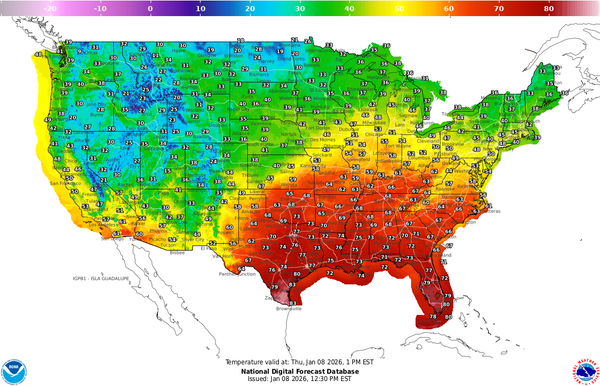
A map of temperatures forecast for the contiguous U.S. on January 8, 2026.
It’s January, which typically means heating bills go up as the temperature goes down. But for some people in the U.S. South, the demand will be for more air-conditioning, as temperatures soar 20 to 35 degrees Fahrenheit (11 to 19 degrees Celsius) above average—and even to record-breaking heights in some spots.
The unseasonal heat stems from an area of high pressure moving across the eastern U.S., pulling in warm air from the south and the record-breaking warm waters of the Gulf of Mexico.
The first records started to fall as a result of the weather system on Tuesday, with a high of 82 degrees F (28 degrees C) in Houston, Tex., 74 degrees F (23 degrees C) in Tulsa, Okla., and 81 degrees F (27 degrees C) in Baton Rouge, La.
On supporting science journalism
If you’re enjoying this article, consider supporting our award-winning journalism by subscribing. By purchasing a subscription you are helping to ensure the future of impactful stories about the discoveries and ideas shaping our world today.
Wide swaths of the eastern U.S. will see temperatures well above average—and some could set records. In the Rio Grande Valley of Texas, temperatures could even reach into the 90s F (mid-30s C). Brian Hurley, a meteorologist at the National Weather Service’s Weather Prediction Center, says that 31 stations across that area could set records or come close. “That’s significant,” he says.
The nights will be particularly hotter than normal—a hallmark of global warming. Overnight lows are rising twice as fast as daytime highs, according to Climate Central, a nonprofit research and news organization.
Climate Central’s Climate Shift Index tool calculates that the high temperatures seen during this January heat event have been made anywhere from 1.5 to five times more likely because of climate change, depending on the day and location.
The system follows hot on the heels of a heat wave that passed across the southern U.S. at the end of last year; December 25, 2025, was the hottest Christmas Day on record for the contiguous U.S by a margin of three degrees F (1.7 degrees C). That may sound minimal, but it’s a considerable amount to set a record by, especially over such a large area.
This latest heat will be short-lived; a cold front will sweep across the U.S. ahead of a low-pressure system. Temperatures in the wake of the front are expected to return to normal.
It’s Time to Stand Up for Science
If you enjoyed this article, I’d like to ask for your support. Scientific American has served as an advocate for science and industry for 180 years, and right now may be the most critical moment in that two-century history.
I’ve been a Scientific American subscriber since I was 12 years old, and it helped shape the way I look at the world. SciAm always educates and delights me, and inspires a sense of awe for our vast, beautiful universe. I hope it does that for you, too.
If you subscribe to Scientific American, you help ensure that our coverage is centered on meaningful research and discovery; that we have the resources to report on the decisions that threaten labs across the U.S.; and that we support both budding and working scientists at a time when the value of science itself too often goes unrecognized.
In return, you get essential news, captivating podcasts, brilliant infographics, can’t-miss newsletters, must-watch videos, challenging games, and the science world’s best writing and reporting. You can even gift someone a subscription.
There has never been a more important time for us to stand up and show why science matters. I hope you’ll support us in that mission.


