



What’s the perfect number of cards for playing poker? According to a new mathematical discovery, the answer is the traditional 52. Almost.
In Texas Hold’em poker, players wager on the best five-card hand they can make among the two cards in their hand and the communal ones on the table. Hands are ranked based on their probability of occurring. A full house, for example, with three cards of the same value (fives or kings, for instance) and two cards of another, is less likely than a flush with any five cards of the same suit. A full house therefore beats a flush. In short-deck poker, a variant that removes cards numbered 2 through 5 (called “ranks 2–5”), there are fewer cards of each suit and a flush becomes less likely than a full house. In a recent paper posted to the preprint server arXiv.org, computer scientist Christopher Williamson examines how the game of poker changes as the number of cards per suit increases or decreases. Depending on that number, an interesting paradox can occur, Williamson found—one that’s nearly always avoided in games with a 52-card deck with 13 in each suit.
After a bidding process, poker players will declare their best hands in what’s called the “showdown.” Consider two hands: a one pair, which has one pair of cards with the same value, and a two pair, with two pairs of such cards. In short-deck poker, although a two pair is less likely to appear than a one pair, its showdown probability—the likelihood that it will be the best hand someone has—is actually higher than that of a one pair. If the hand rankings were adjusted to account for this, no one would ever play a two pair over a one pair, which would change its showdown probability once again.
On supporting science journalism
If you’re enjoying this article, consider supporting our award-winning journalism by subscribing. By purchasing a subscription you are helping to ensure the future of impactful stories about the discoveries and ideas shaping our world today.
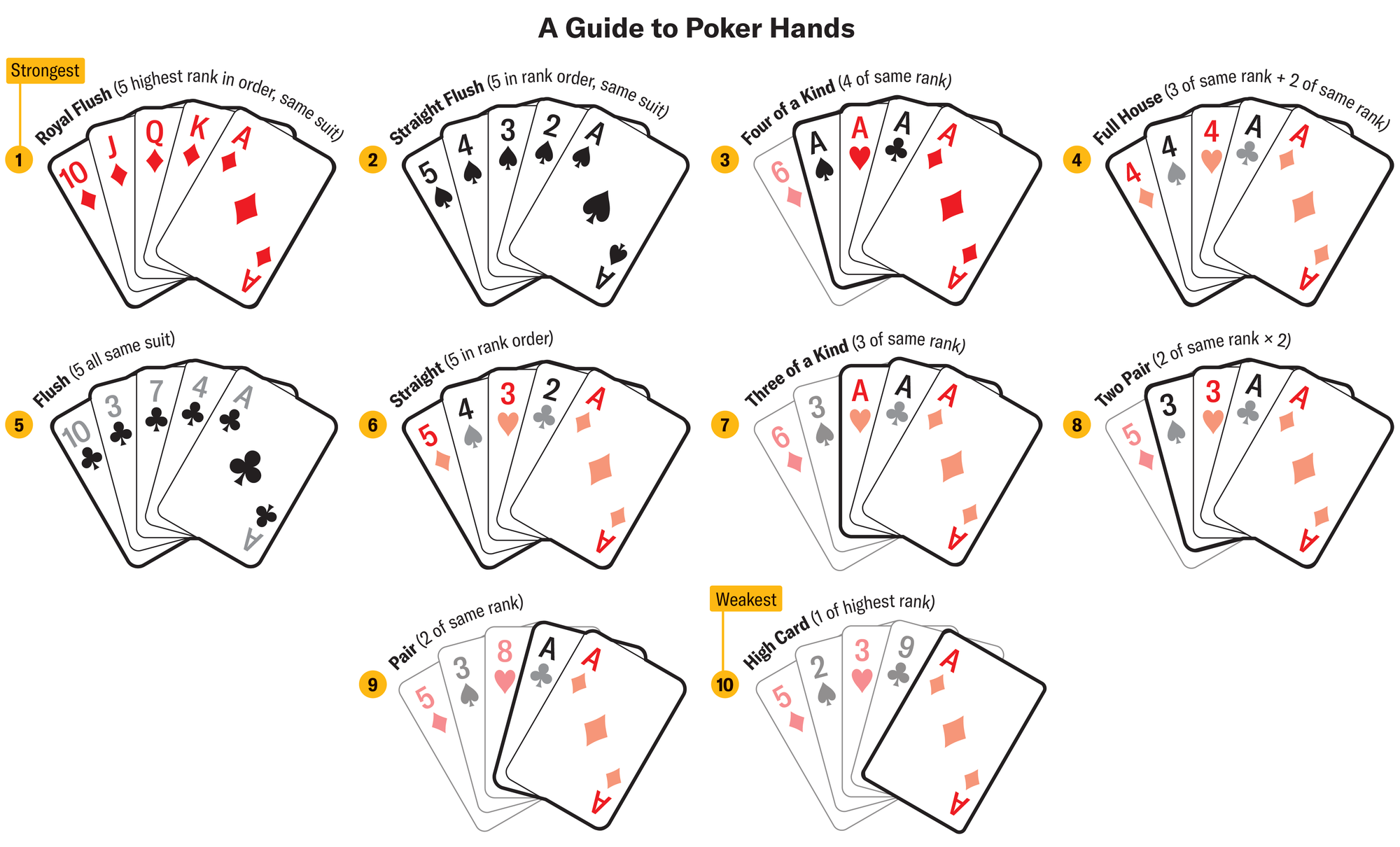
“Thirteen is kind of the sweet spot,” Williamson says regarding how many cards a deck should have in each suit. It’s the smallest number for which the showdown ranking actually matches the standard ranking for all hands other than a single high card (the lowest-ranking hand). Although the usual number of cards in a deck is purely historical—it’s said to symbolize 52 weeks in the year and the four seasons—Williamson was delighted to find a more mathematical justification. There is only one superior setup, which would keep all rankings aligned to their showdown probabilities, including the high card: you’d need 23 cards in each suit, nearly twice as many as in the traditional deck.
Nikita Luther, a top professional poker player, finds the result fascinating. “It’s so complex, the way the variables interact with each other,” she says. Luther says she hasn’t deeply explored variants beyond Texas Hold’em; even there, “I could spend the rest of my life just trying to understand this game.”
It’s Time to Stand Up for Science
If you enjoyed this article, I’d like to ask for your support. Scientific American has served as an advocate for science and industry for 180 years, and right now may be the most critical moment in that two-century history.
I’ve been a Scientific American subscriber since I was 12 years old, and it helped shape the way I look at the world. SciAm always educates and delights me, and inspires a sense of awe for our vast, beautiful universe. I hope it does that for you, too.
If you subscribe to Scientific American, you help ensure that our coverage is centered on meaningful research and discovery; that we have the resources to report on the decisions that threaten labs across the U.S.; and that we support both budding and working scientists at a time when the value of science itself too often goes unrecognized.
In return, you get essential news, captivating podcasts, brilliant infographics, can’t-miss newsletters, must-watch videos, challenging games, and the science world’s best writing and reporting. You can even gift someone a subscription.
There has never been a more important time for us to stand up and show why science matters. I hope you’ll support us in that mission.


