




Hawaii’s Kilauea Volcano Absolutely Destroys This Webcam in a Fiery New Video
Hawaii’s Kilauea, one of Earth’s most active volcanoes, sent lava fountains spewing into the air, obliterating a U.S. Geological Survey camera
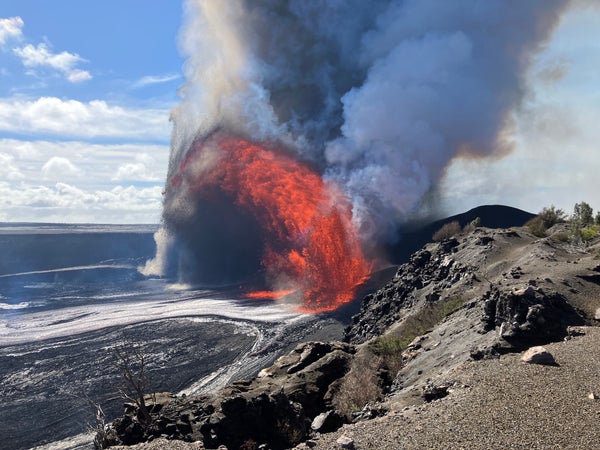
Lava fountains are seen at both the north and south vents of Kilauea’s summit around 10:00 A.M. local time on December 6, 2025.
Hawaii’s Kilauea—one of Earth’s most active volcanoes—is bringing the drama.
On December 6 lava fountains in the Halema‘uma‘u crater at the shield volcano’s summit spewed more than 1,000 feet into the air, sending molten rock, boulders and ash hurtling into one of the U.S. Geological Survey’s webcams, taking it completely offline.
On supporting science journalism
If you’re enjoying this article, consider supporting our award-winning journalism by subscribing. By purchasing a subscription you are helping to ensure the future of impactful stories about the discoveries and ideas shaping our world today.
The volcano is going through a long, intermittent eruption that began on December 23, 2024. Kilauea, located on the southeastern flank of Mauna Loa on the island of Hawai‘i, has blown dozens of times since the 1950s. In fact, it erupted practically uninterrupted from 1983 to 2018 along its East Rift Zone—only ending when the floor of the Pu‘u ‘Ō‘ō crater collapsed, draining the lava lake at the volcano’s summit. The lava poured through residential neighborhoods, destroying hundreds of homes and other buildings.
A 2019 paper revealed that fissures inside Kilauea caused a relatively small amount of magma to drain from the volcano’s reservoir, ultimately setting off the collapse of the summit caldera.
It’s Time to Stand Up for Science
If you enjoyed this article, I’d like to ask for your support. Scientific American has served as an advocate for science and industry for 180 years, and right now may be the most critical moment in that two-century history.
I’ve been a Scientific American subscriber since I was 12 years old, and it helped shape the way I look at the world. SciAm always educates and delights me, and inspires a sense of awe for our vast, beautiful universe. I hope it does that for you, too.
If you subscribe to Scientific American, you help ensure that our coverage is centered on meaningful research and discovery; that we have the resources to report on the decisions that threaten labs across the U.S.; and that we support both budding and working scientists at a time when the value of science itself too often goes unrecognized.
In return, you get essential news, captivating podcasts, brilliant infographics, can’t-miss newsletters, must-watch videos, challenging games, and the science world’s best writing and reporting. You can even gift someone a subscription.
There has never been a more important time for us to stand up and show why science matters. I hope you’ll support us in that mission.


