




Tsunami Warnings Issued in Japan after Magnitude 7.6 Earthquake
Japanese officials said to expect a tsunami of up to 3 meters in some areas after a magnitude 7.6 earthquake struck off the east coast of Japan
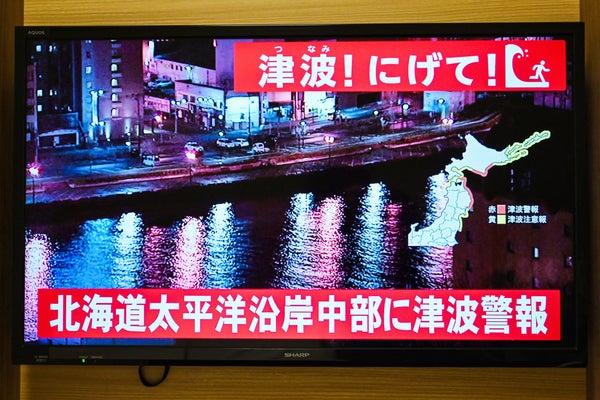
An advisory reading “Tsunami! Run!” (top) and “Tsunami warning issued for central Hokkaido’s Pacific Coast” flashes over the live footage of a shore on a television screen in Sapporo, in Japan’s northern Hokkaido prefecture, on December 9, 2025.
Greg Baker/AFP via Getty Images
Japanese officials issued tsunami warnings and evacuation orders for the country’s northeast coast on Monday after a magnitude 7.6 earthquake struck 80 kilometers off the coast at 11:15 P.M. local time. An Initial tsunami has been observed in some areas, with waves of half a meter hitting the worst-affected regions.
Railway service has been suspended in the area and thousands are reportedly without power, but so far, no issues have been reported at any nuclear power plants, according to Reuters.
Japan experienced a devastating tsunami and a catastrophic disaster at the Fukushima Daiichi nuclear power plant after a magnitude 9 earthquake hit in 2011. That earthquake was the fourth-largest ever recorded, according to the U.S. Geological Survey. The tsunami it created reached up to 40.5 meters.
On supporting science journalism
If you’re enjoying this article, consider supporting our award-winning journalism by subscribing. By purchasing a subscription you are helping to ensure the future of impactful stories about the discoveries and ideas shaping our world today.
Japan is one of the most earthquake-prone countries on Earth because of its location along the Pacific “Ring of Fire,” where tectonic plates grind against one another.
The U.S. National Tsunami Warning Center has said there are currently no tsunami concerns for the U.S. or Canada.
Editor’s note: This is a developing story and may be updated.
It’s Time to Stand Up for Science
If you enjoyed this article, I’d like to ask for your support. Scientific American has served as an advocate for science and industry for 180 years, and right now may be the most critical moment in that two-century history.
I’ve been a Scientific American subscriber since I was 12 years old, and it helped shape the way I look at the world. SciAm always educates and delights me, and inspires a sense of awe for our vast, beautiful universe. I hope it does that for you, too.
If you subscribe to Scientific American, you help ensure that our coverage is centered on meaningful research and discovery; that we have the resources to report on the decisions that threaten labs across the U.S.; and that we support both budding and working scientists at a time when the value of science itself too often goes unrecognized.
In return, you get essential news, captivating podcasts, brilliant infographics, can’t-miss newsletters, must-watch videos, challenging games, and the science world’s best writing and reporting. You can even gift someone a subscription.
There has never been a more important time for us to stand up and show why science matters. I hope you’ll support us in that mission.


