




China’s CO2 Emissions Might Have Finally Peaked
China has rapidly become the world leader in renewable energy, but continued coal use means it could take longer for its emissions to decline
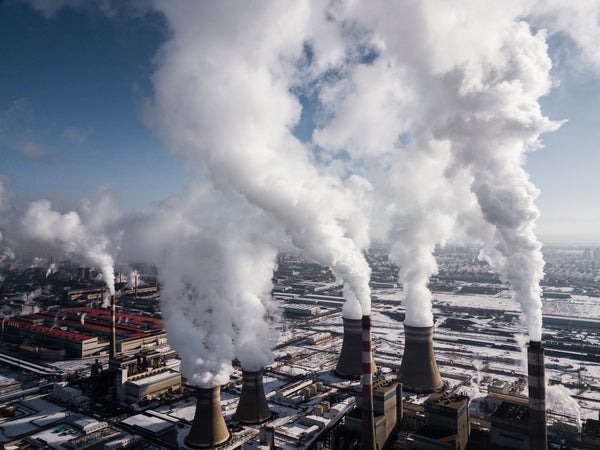
A coal-fired power plant in China.
AerialPerspective Images/Getty Images
China’s carbon dioxide emissions have plateaued in 2025, indicating the country may have reached a peak after years of being the world’s top emitter.
The plateau reflects how China’s record-setting build-out of wind and solar power and rapid expansion into electric vehicles has tempered fossil-fuel emissions, according to the nonprofit Center for Research on Energy and Clean Air.
China accounts for around one third of all global greenhouse gas emissions, although historically the U.S. has emitted more carbon. Russia, the U.S. and the European Union long ago used up their “carbon budget” that would allow the world to meet the Paris Agreement goal of keeping global warming below 2 degrees Celsius above preindustrial levels. China’s swift industrial growth—and its burning of coal—means that it is now close to using up its own budget, too.
On supporting science journalism
If you’re enjoying this article, consider supporting our award-winning journalism by subscribing. By purchasing a subscription you are helping to ensure the future of impactful stories about the discoveries and ideas shaping our world today.
China has become a world leader in renewable energy, but it is also still adding coal-fired power plants to meet growing power demand. Still, if the flat emissions level is maintained, Beijing could see its emissions peak before its stated 2030 goal. Bringing emissions down from that peak, however, could remain a challenge.
“[A prolonged plateau] would push the world further off course from the Paris Agreement temperature goals,” Li Shuo, director of the China Climate Hub at the Asia Society Policy Institute, told E&E News’s Climatewire.
It’s Time to Stand Up for Science
If you enjoyed this article, I’d like to ask for your support. Scientific American has served as an advocate for science and industry for 180 years, and right now may be the most critical moment in that two-century history.
I’ve been a Scientific American subscriber since I was 12 years old, and it helped shape the way I look at the world. SciAm always educates and delights me, and inspires a sense of awe for our vast, beautiful universe. I hope it does that for you, too.
If you subscribe to Scientific American, you help ensure that our coverage is centered on meaningful research and discovery; that we have the resources to report on the decisions that threaten labs across the U.S.; and that we support both budding and working scientists at a time when the value of science itself too often goes unrecognized.
In return, you get essential news, captivating podcasts, brilliant infographics, can’t-miss newsletters, must-watch videos, challenging games, and the science world’s best writing and reporting. You can even gift someone a subscription.
There has never been a more important time for us to stand up and show why science matters. I hope you’ll support us in that mission.


