




James Webb Space Telescope Spots Swirling Cradle for Exomoons
Scientists found evidence of a distant planet’s moon system forming
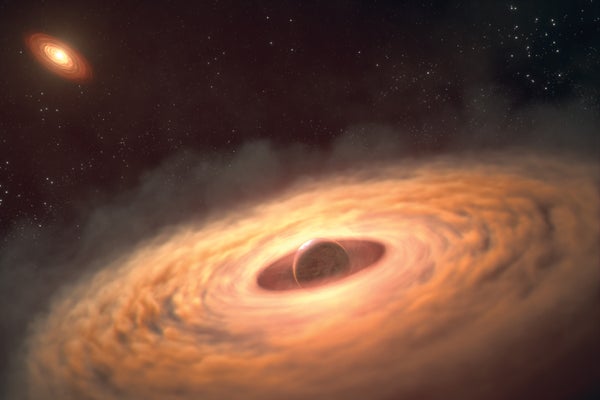
An illustrated moon-forming disk surrounds an alien planet.
NASA, ESA, CSA, STScI, Gabriele Cugno/University of Zürich, NCCR PlanetS, Sierra Grant/Carnegie Science, Joseph Olmsted/STScI, Leah Hustak/STScI
For the first time, scientists have directly detected molecules in a Frisbee of gas and dust swirling around an alien gas-giant planet. “I didn’t think this was possible,” says astronomer Sierra Grant of Carnegie Science in Washington, D.C. Typically such a faint signal would be invisible in the glare of a star. Grant and her co-author Gabriele Cugno of the University of Zürich, who published the results recently in the Astrophysical Journal Letters, think the carbon-rich disk is a lunar nursery and already have plans to observe several more; eventually researchers might be able to detect gaps carved in such disks by nascent moons.
Grant and Cugno used the James Webb Space Telescope (JWST) to pick out the infrared glow from the disk of gas and dust encircling a Goliath world called CT Cha b. Spotting light cast by a planet—let alone a disk around one—is like making out a firefly against a floodlight. It’s easier if the firefly is enormous and far away from the light. CT Cha b weighs a whopping 14 to 24 Jupiter masses and orbits its star about 17 times farther out than Neptune does the sun.
Previous observations had hinted that CT Cha b was gobbling up material from a yet unseen disk, and Cugno aimed to disentangle this disk’s glow of infrared heat from the star’s bright gleam. Grant was skeptical it could be done, but Cugno wanted to test JWST’s limits. “It was almost a game,” he says.
On supporting science journalism
If you’re enjoying this article, consider supporting our award-winning journalism by subscribing. By purchasing a subscription you are helping to ensure the future of impactful stories about the discoveries and ideas shaping our world today.
Cugno ultimately pulled a “beautiful” light spectrum of the disk out of the data, in which Grant spotted clear chemical fingerprints of carbon-rich compounds such as hydrogen cyanide, acetylene and even molecules as complex as six-carbon benzene rings—substances absent from the material swirling directly around CT Cha b’s star. The disk could be a moon-building zone around the planet.
“This might give us a hint about what material is available for the formation of exomoons,” says astrophysicist Danny Gasman of the Max Planck Institute for Astronomy in Germany, who wasn’t involved in the study. She cautions, however, that although CT Cha b’s size and extreme distance from its star make it a great target, they also mean that it might be more like a failed star than a typical gas giant.
Even in our own solar system, the origins of moons remain mysterious. Disks such as CT Cha b’s offer a chance to understand not only moons of alien systems but also the moons in ours. “It’s really hard to go back in time 4.5 billion years and imagine how they were created,” Cugno says. “Now we can actually see this process.”
It’s Time to Stand Up for Science
If you enjoyed this article, I’d like to ask for your support. Scientific American has served as an advocate for science and industry for 180 years, and right now may be the most critical moment in that two-century history.
I’ve been a Scientific American subscriber since I was 12 years old, and it helped shape the way I look at the world. SciAm always educates and delights me, and inspires a sense of awe for our vast, beautiful universe. I hope it does that for you, too.
If you subscribe to Scientific American, you help ensure that our coverage is centered on meaningful research and discovery; that we have the resources to report on the decisions that threaten labs across the U.S.; and that we support both budding and working scientists at a time when the value of science itself too often goes unrecognized.
In return, you get essential news, captivating podcasts, brilliant infographics, can’t-miss newsletters, must-watch videos, challenging games, and the science world’s best writing and reporting. You can even gift someone a subscription.
There has never been a more important time for us to stand up and show why science matters. I hope you’ll support us in that mission.


